Prodigent
Prodigent Jira

Resources

Product intent in Prodigent. Delivery in Jira.

Prodigent is where your team defines product requirements and captures all the context behind them. Its output feeds into Jira — so engineering starts from clear intent, not disconnected tickets.

Prodigent

Product intelligence

Where you define what to build and why. Capture feedback, decisions, open questions, and the reasoning behind them as your initiative evolves.

  • Living product context across Slack, meetings, and research
  • Decisions linked to the evidence that shaped them
  • Initiative snapshots and PRDs generated from real reasoning
  • A durable record of what the team knows right now

Jira

Delivery

Where work gets planned, prioritized, and shipped. Epics, stories, and sprints — the system your engineering team runs on every day.

  • Issues scoped for implementation
  • Sprint and release planning
  • Status, ownership, and progress tracking
  • The execution layer your team already trusts

Two tools, one workflow

Most teams already run delivery in Jira. The gap is upstream — turning conversations, feedback, and decisions into requirements that stay current. That is what Prodigent is built for.

Prodigent answers

  • → Why are we building this?
  • → What did customers and stakeholders say?
  • → What did we decide — and what did we reject?
  • → What is still open before we commit?

Jira answers

  • → What are we building this sprint?
  • → Who owns each piece of work?
  • → What is blocked or in progress?
  • → When does it ship?

From scattered context to structured delivery.

Prodigent sits upstream of Jira in your product workflow. You capture and shape requirements in one place — then feed that output into the tool your team uses to ship.

  1. 1

    Capture context as it happens

    Send Slack threads, customer feedback, and meeting notes into Prodigent. Decisions and open questions stay connected to the initiative — not scattered across tabs.

  2. 2

    Shape clear product requirements

    Turn live context into structured output: background, scope, key decisions, open questions, and requirements your team can actually align on.

  3. 3

    Feed output into Jira

    Push initiative summaries, requirements, and linked context into Jira epics and stories — so tickets carry the why, not just the what.

  4. 4

    Build with full intent

    Engineering picks up work in Jira with product reasoning attached. When context shifts in Prodigent, your source of truth updates before specs drift.

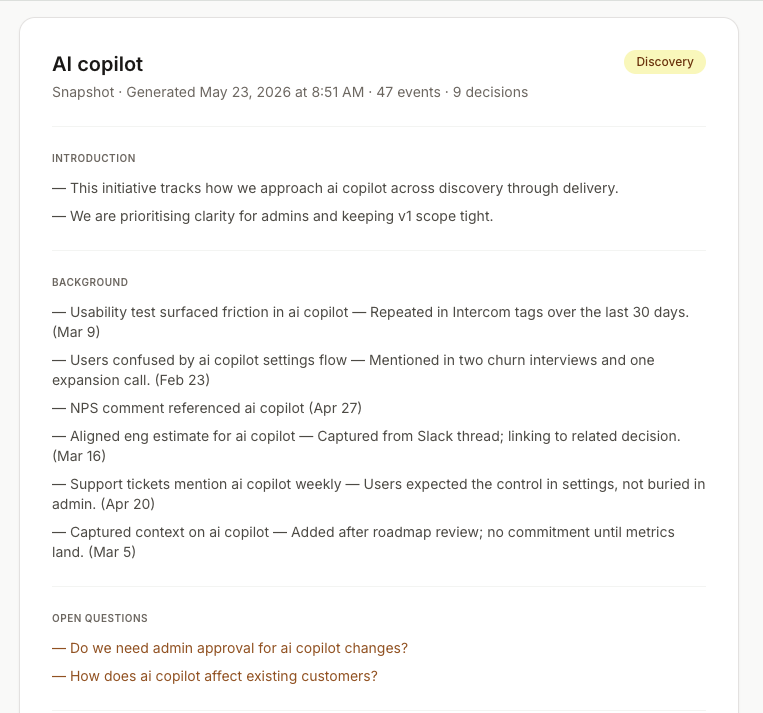
Prodigent initiative snapshot with requirements, decisions, and open questions ready to feed into Jira

What flows from Prodigent into Jira

When requirements are ready for engineering, Prodigent gives you structured output — not a copy-paste from five different sources.

Initiative snapshots

A structured summary — introduction, background, key decisions, open questions — ready to attach to a Jira epic or project.

Requirements and scope

Clear, current requirements grounded in captured context — not a stale Confluence page from last quarter's planning session.

Decision history

The trade-offs and alternatives your team considered, linked to the evidence behind each call.

Open questions

Unresolved items surfaced explicitly, so engineering knows what is decided vs. still in play.

Why not just write tickets in Jira?

Jira is excellent at tracking work — but issue titles and descriptions were never designed to hold the full story of how a product decision was made. Feedback arrives in Slack. Trade-offs happen in standup. Scope shifts after a customer call. If that context never reaches the ticket, engineering builds against an incomplete picture.

Prodigent keeps the reasoning layer alive and connected. When you are ready to hand off, the output — requirements, decisions, open questions, and background — feeds into Jira so your team ships from shared understanding, not guesswork.

Start with connected product context.

Capture your first initiative in Prodigent — then bring structured requirements into Jira when your team is ready to build.